 comparison
AI Sales Software Review for 2026: Top Tools Compared
Table of Contents
- AI Sales Software Review for 2026: What Actually Changed
- Best AI Sales Tools 2026: Quick Comparison Table
- AI CRM Software: Where Customer Data Meets Sales Workflow
- AI Sales Coaching Software and Conversation Intelligence
- AI Sales Software Implementation: Time to Value and Total Cost
- AI Accuracy, Data Privacy, and Governance Questions to Ask
- Which Platform Fits Your Sales Motion?
- Frequently Asked Questions
Last Updated: October 8, 2026
AI Sales Software Review for 2026: What Actually Changed
The biggest shift in AI sales software this year isn't a new feature. According to Gartner's research on AI trust and buying behavior, most B2B software buyers now want proof of accuracy and governance before they sign, not after.
AI sales software is any platform that uses machine learning to handle part of the sales process: scoring leads, drafting outreach, forecasting pipeline, or analyzing calls. Apollo.io, Gong, HubSpot, and Amplemarket all appear in current comparisons.
How We Evaluated These Platforms
We score platforms on five criteria: pricing transparency, time to value, AI accuracy and data governance, CRM integration depth, and measurable sales outcomes. A demo that impresses in twenty minutes can still take six months to pay off, so we weight implementation effort heavily.
Best AI Sales Tools 2026: Quick Comparison Table
Most roundups rank tools by feature count, the wrong axis. A 200-feature platform a five-person team cannot configure is worth less than a 40-feature platform they run without a consultant. We publish our rubric so you can re-run it against any tool we did not cover.
Our Scoring Rubric (100 points)
| Criterion | Weight | What Earns a High Score | What Loses Points |
|---|---|---|---|
| Pricing transparency | 20 | Published per-seat rates, no mandatory implementation fee, month-to-month option | "Contact sales" only, annual lock-in, seat minimums buried in the order form |
| Time to value | 20 | Working pipeline in under 30 days without a paid onboarding package | Multi-month rollout, mandatory professional services |
| AI accuracy and governance | 20 | Documented model behavior, opt-out of training data, written data-processing agreement, audit log | Vague "AI-powered" claims, no opt-out, no DPA before signature |
| CRM integration depth | 20 | Two-way sync with your existing CRM, field-level mapping, no duplicate record creation | One-way export, CSV-only, forces you onto the vendor's CRM |
| Measurable sales outcomes | 20 | Vendor or customer data tying the tool to win rate, cycle length, or rep productivity | Testimonials with no metric attached |
The Comparison
| Platform | Best For | Standout Strength | Main Trade-off | Pricing Model to Expect |
|---|---|---|---|---|
| Megan Driscoll Consulting | Firms that need a working system, not just software | Hands-on implementation with a prioritized acquisition playbook | A tailored engagement, not a self-serve signup | Project-based engagement, scoped after a strategic business audit |
| Apollo.io | Teams comparing outreach and lead-data coverage | Broad prospecting coverage with CRM syncing | Free tier is generous but caps export and sequence volume; paid tiers are per-seat and rise with contact credits | Freemium with tiered per-seat plans; contact credits are the real cost driver |
| Gong | Teams focused on call coaching | Conversation intelligence for coaching and deal review | Priced for teams with real call volume; small teams rarely generate enough data to justify it | Per-seat, annual contract, quote-based |
| HubSpot | Businesses wanting one connected platform | CRM and sales tools in a single ecosystem | AI features are strongest on higher tiers; costs stack as you add seats and marketing contacts | Free CRM, then tiered per-seat bundles; contact tiers add cost |
| Amplemarket | Outreach-heavy teams | Duo AI is described as producing human-sounding outreach | Pricing and free-tier details are quote-based, so budget approval is harder | Quote-based, typically annual |
How to Read This Table Without Getting Burned
Three cost traps recur in small and mid-size B2B purchases:
- Contact credits, not seats, are the real bill. Prospecting tools meter email credits, phone credits, and enrichment lookups. A 10-seat plan can cost more than a 25-seat plan if one team burns credits faster.
- Onboarding is often a separate line item. Ask whether implementation, data migration, and admin training are included or billed at a professional-services rate.
- Annual lock-in hides the true monthly cost. A discounted annual price is only cheaper if you are still using the tool in month nine. Ask for a month-to-month option first.
What We Could Not Verify
We will not invent pricing. Where a vendor does not publish current rates, we say so rather than guess. Treat any roundup quoting exact per-seat prices without a date and source as unreliable, pricing changes more than once a year, and seat minimums are frequently negotiated.
For the fastest read on fit, ignore the feature grid and answer one question: how much of the setup work will your team do alone after the invoice clears? That predicts your outcome better than any comparison table.
AI CRM Software: Where Customer Data Meets Sales Workflow
AI CRM software matters because it decides what your reps see first. A CRM that ranks leads by likelihood to close changes how a team spends its day; one that just stores contacts changes nothing.
The practical difference shows up in three places:
- Lead scoring: the system ranks inbound leads so reps call the right ones first
- Personalization: outreach references a prospect's actual context, not a mail-merge field
- Follow-up: sequences trigger automatically when a prospect opens, clicks, or goes quiet
What most guides miss: AI features are only as good as the data underneath them. If your CRM has duplicate records and stale fields, the AI will confidently rank the wrong leads.
AI Sales Coaching Software and Conversation Intelligence
Conversation intelligence tools record, transcribe, and analyze sales calls, then surface what top performers do differently. Gong is the best-known name here. But the category is easy to buy badly: value depends on call volume, manager behavior, and how the tool handles recordings. Integrating these platforms into a broader tech stack requires careful attention to enterprise AI security to ensure that sensitive customer data remains protected throughout the automated analysis process.
How the Mechanism Actually Works
Strip away the marketing and most platforms do the same four things:
- Capture and transcribe. The tool joins or records the call, then converts speech to text. Accuracy varies by accent, audio quality, and crosstalk.
- Tag and structure. The transcript is segmented into topics, competitor mentions, objections, pricing discussions, and next steps. Bad tagging produces noise, not insight.
- Score and compare. Calls are scored against a rubric or your top reps' patterns, so a manager can see which deals are stalling and why.
- Surface and alert. The system flags at-risk deals, missed next steps, or coaching moments, ideally inside the CRM.
If any of those four steps is weak, the whole chain degrades. A perfectly tagged transcript nobody reviews is an expensive archive.
When It Pays Off, and When It Does Not
Coaching tools help when:
- You have enough call volume to find patterns, a common threshold is a few hundred recorded calls per quarter; below that, you are reading anecdotes with a dashboard.
- Managers will actually review the flagged calls. If your sales manager is also your top rep, they will not.
- Reps trust the tool enough to stop performing for it. Once reps believe they are graded on talk time, they change how they sell and the data stops reflecting reality.
Where it falls short: small teams with fewer than a few hundred calls a quarter rarely generate enough data to be useful. The tool sits idle and the subscription keeps billing. Spend the money on a repeatable sales process first, coaching software amplifies a good process, it does not create one.
The Governance Problem Nobody Puts in the Demo
Recording customer calls creates obligations a lead-scoring tool does not. Before you buy, get written answers to these:
- Consent. Does the platform handle two-party consent requirements and announce recording automatically? Several states require all-party consent, and default settings may not match your prospects' locations.
- Retention. How long are recordings and transcripts stored, and can you set a shorter window? Long retention is a liability if a customer asks you to delete their data.
- Training data. Are your calls used to train the vendor's models? Ask for an opt-out in writing, not a verbal assurance.
Build, Buy, or Skip
| Your Situation | Sensible Move |
|---|---|
| Fewer than a few hundred calls per quarter | Skip. Invest in a documented sales process and call scripts first. |
| 300-1,000 calls per quarter, one manager | Buy a mid-tier plan, but only if the manager has blocked calendar time to review flagged calls weekly. |
| 1,000+ calls per quarter, multiple teams | Buy, and budget for an admin who owns tagging rules and scorecards. |
| Regulated industry or sensitive call content | Buy only after legal signs off on consent, retention, and redaction settings. |
The real test is not whether the tool can transcribe a call, but whether your team will change one behavior because of what the transcript showed. If you cannot name that behavior in advance, the subscription is a recording service, not a coaching tool.
AI Sales Software Implementation: Time to Value and Total Cost
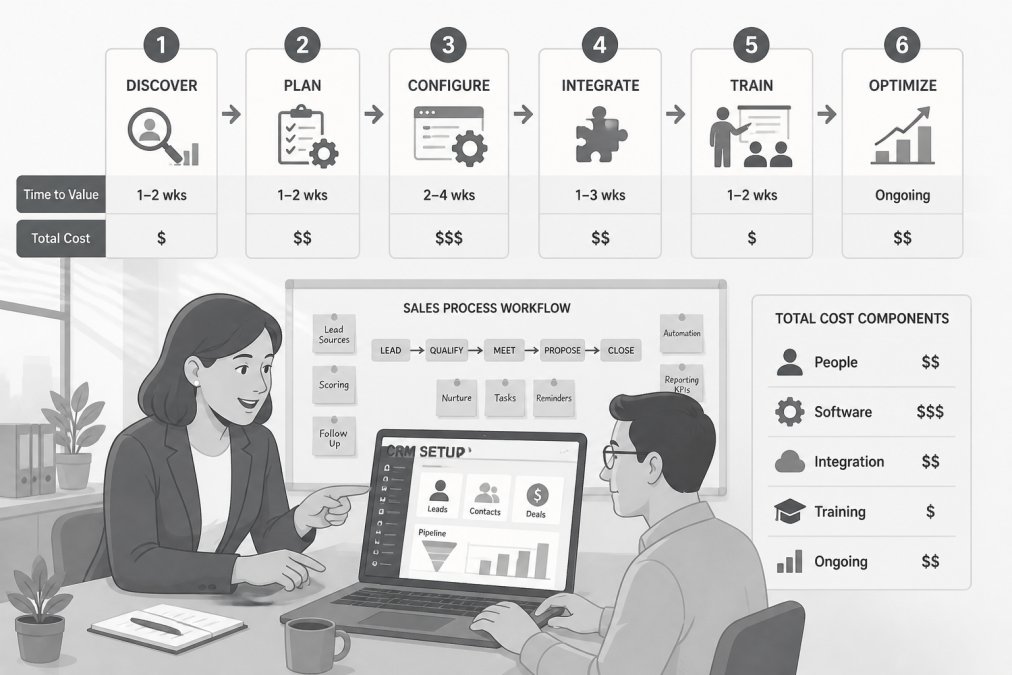
Implementation is where budgets quietly double. The license is the visible cost; the hidden costs are data cleanup, integration work, team training, and weeks of reduced selling while everyone learns the system.
A realistic breakdown for a small B2B firm:
| Phase | Typical Effort | What It Involves |
|---|---|---|
| Data cleanup | 1-3 weeks | Deduplicating records, standardizing fields, removing dead leads |
| Integration | 1-2 weeks | Connecting email, calendar, and existing tools |
| Workflow build | 2-4 weeks | Scoring rules, sequences, and handoff logic |
| Team adoption | 4-8 weeks | Training, shadowing, and adjusting based on real use |
This is where a hands-on implementation partner earns its keep. Megan Driscoll Consulting starts with a strategic business audit to find operational bottlenecks, then builds a prioritized acquisition playbook so the system matches how your firm actually sells.
AI Accuracy, Data Privacy, and Governance Questions to Ask
Before you sign, ask vendors five questions. The answers tell you more than any demo.
- Where does the AI get its training data, and can we opt out?
- Where is our customer data stored, and who can access it?
- How does the platform handle a wrong AI recommendation?
- What happens to our data if we leave?
- Can we audit what the AI did and why?
Governance isn't a legal formality. It's a sales risk. If an AI drafts outreach that misrepresents your firm, you own the consequences, not the vendor. The Federal Trade Commission's guidance on business data practices is worth reading before you hand customer data to any platform.
Which Platform Fits Your Sales Motion?
Match the tool to how you actually sell, not to the demo that looked best.
- High-volume outbound: prioritize prospecting coverage and deliverability. Apollo.io and Amplemarket both appear in comparisons for this use case.
- Consultative, long-cycle sales: prioritize conversation intelligence and CRM depth. Gong fits teams with real call volume.
- Small firm that needs the system built: prioritize implementation support over feature count. This is where Megan Driscoll Consulting works, combining smart automation with human relationships so the process stays personal.
The real difference between platforms isn't the feature list, it's how much of the work you do yourself after you buy.
Scaling a sales team without adding headcount is the hard part, and most tools leave the implementation to you. Megan Driscoll Consulting builds the system with you: a strategic business audit to find the bottlenecks, a prioritized acquisition playbook to fix them, and AI-powered lead generation and follow-up wired into how your team already sells.
Frequently Asked Questions
What should small businesses look for in AI sales software?
Prioritize CRM integration, lead qualification accuracy, and how much setup work falls on your team. A platform that syncs with your existing CRM and automates follow-up saves more time than one with dozens of unused features. Ask vendors how long onboarding takes, whether pricing scales per seat, and how the tool handles your customer data. For small teams, time to value matters more than feature count.
How does AI sales software work with a CRM?
AI sales software typically reads and writes to your CRM through an integration, pulling customer data to score leads, draft outreach, and log activity automatically. Some platforms, like AI-native CRM tools, build the AI directly into the database. Others connect to systems like HubSpot or Salesforce. The practical difference shows up in syncing reliability and whether your sales team has to update records manually or the tool does it for them.
Can AI sales tools help qualify leads and automate follow-ups?
Yes, and that is where most small teams see the fastest payoff. AI sales tools score inbound leads against patterns from your closed-won deals, route qualified leads to the right rep, and trigger follow-up sequences when a prospect opens an email or visits a pricing page. The automation handles repetitive touches so your team can spend time on conversations that need a human. Start with one workflow, measure response rates, then expand.
What are the limitations of AI sales software?
AI models reflect the data they are trained on, so messy CRM records produce unreliable lead scores and generic outreach. Accuracy also varies by industry: a tool trained on high-volume B2B SaaS deals may misfire on long-cycle professional services sales. Data privacy and governance matter too, especially if you handle sensitive client information. Plan for a cleanup phase before implementation, and keep a human reviewing AI-drafted messages before they send.